AI tools shortlist
Best AI tools for small business: the one that catches supplier price hikes before you quote at old prices
The best AI tool for a small business runs a job by itself: it reads every supplier bill and flags price hikes before you quote at old costs.
The short answer
Your quotes stay priced at what materials cost this week, because AI reads every supplier bill the day it arrives and emails you only the prices that moved. That is the best kind of AI tool for a small business: not a chat window you have to remember to open, but a job that runs by itself and hands you a finished result. For a fencing or concrete contractor, the most useful one we know watches supplier bills and catches price creep, new surcharges and overcharges before they eat the margin on jobs you haven't built yet.
What it costs you now
Here's how it usually goes. Supplier bills land in the office inbox or get forwarded into the books. Someone (the owner, or whoever does the books two afternoons a week) checks that the total looks about right and pays it. Nobody holds this week's price for 2-3/8" steel posts up against the bill from three weeks ago. Nobody checks the cedar pickets against the price the yard quoted on the 1st. The new fuel line on the ready-mix ticket goes through because it's small.
Meanwhile the estimate template still carries the post price from spring. Every quote that goes out this month is priced off a cost that no longer exists. You win the job, you build it, and the margin you counted on is quietly gone.
This isn't a rare month. The Associated General Contractors of America reported on 15 October 2026 that input prices for nonresidential construction rose 11.9% from September 2025 to September 2026, the most in four years, and that firms "appear to be absorbing most of the cost increases." Steel mill products were up 27.6%, truck freight 19.3%, and precast concrete 10.5% (AGC, 15 Oct 2026). Those are national indexes, not your yard's prices, but they show which way the bills are moving.
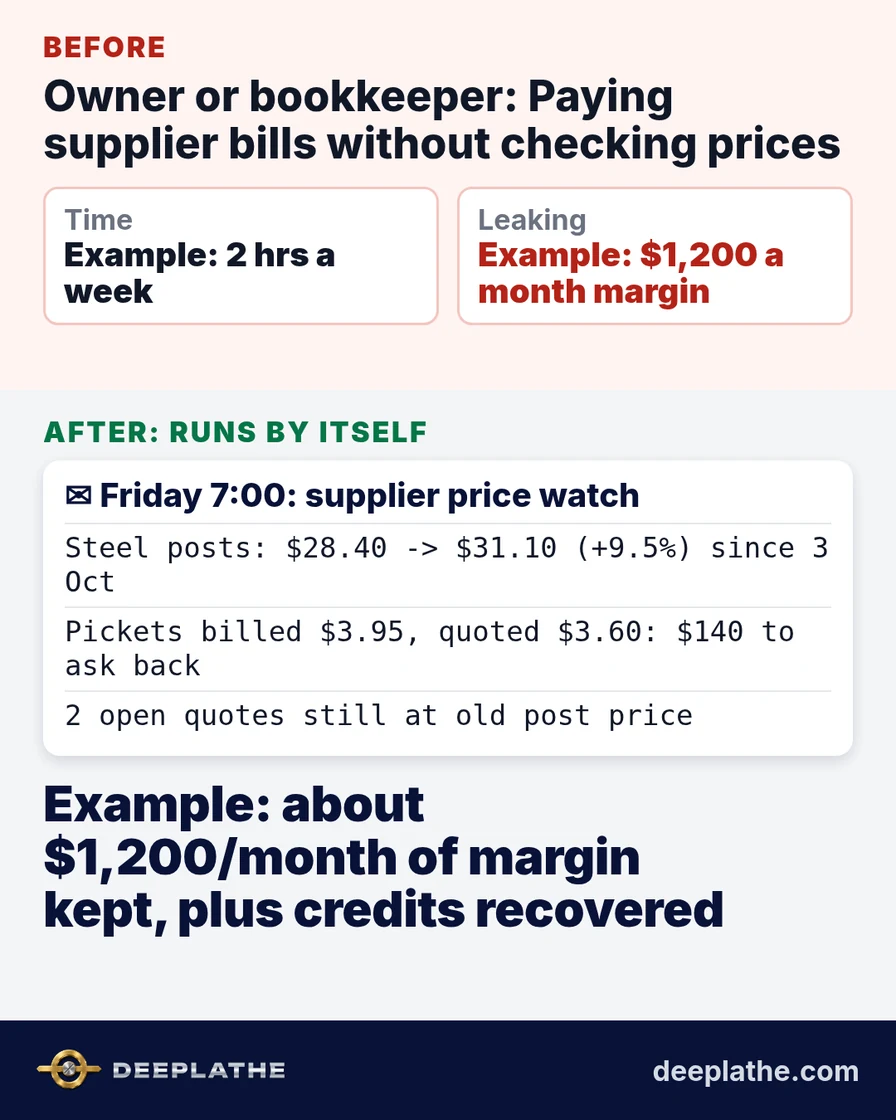
Example of the leak: a fence and concrete outfit buys $30,000 of materials a month. If unit prices drift up 4% and the estimate template doesn't follow, that's about $1,200 a month of margin handed back on new jobs. Add one overbilled delivery or line item a month at around $150 that nobody disputes. Doing the checking by hand would take roughly 2 hours a week of someone's time, which is why it mostly doesn't happen.
What runs by itself
It watches three things the business already has: supplier bills as they arrive (in email, or as draft bills in Xero or QuickBooks), the supplier's own quotes and price sheets sitting in the inbox, and the material prices in your estimate template or price list.
Every time a bill comes in, AI reads the line items and compares each unit price with the last few bills from that supplier for the same item, and with any quote that supplier sent you. It writes one row per change to a running sheet: item, old price, new price, percent, which bill. It skips anything that matches. It also picks out new lines that weren't there before, such as fuel, delivery or "small order" surcharges.
Once a week, on Friday morning, it reads that sheet next to your open quotes and sends you one short email. It lists what went up, what got billed above the supplier's own quote, and which quotes you've sent but not yet won are still priced at the old cost. If nothing moved, you get a one-line "no changes" email. Nobody opens the bills, nobody builds a spreadsheet, nobody asks the AI anything.
It runs inside your accounting software and email, connected once; nobody operates it after that. We can set this up for you inside the accounts you already have.
Example: what lands in your inbox
Illustrative example (made-up suppliers and jobs, to show the shape of the result):
Supplier price watch, Fri 7:00. 23 bills read this week.
Steel line posts 2-3/8" (Northside Supply): $28.40 -> $31.10 each (+9.5%) since the 3 Oct bill.
Ready-mix (Valley Concrete): new $65 fuel surcharge on 2 of 3 delivery tickets.
Cedar pickets 6 ft: billed $3.95, their 1 Oct quote said $3.60. 400 pcs = $140 to ask back.
Open quotes still at old post price: Henderson 180 ft chain link, Ortiz driveway + gate.
Everything else matched.
You do two things with it: ask the yard for the $140 credit, and update the two quotes (or your price list) before you send the next one.
The time and money math
Assumptions (Example, not a measured result): $30,000 of materials a month, 4% average price drift that would otherwise go unnoticed, one overbilled line a month at $150, and 2 hours a week that a careful bookkeeper would need to check every bill by hand at $35 an hour.
Time back: about 8 to 9 hours a month of bill-checking drops to zero. What's left is the 5 minutes on Friday spent reading the email and acting on it.
Money effect, cost side: Example: $150 a month in credits recovered from overbilling, plus $65 surcharges you can now push back on or build into delivery pricing.
Money effect, margin side: Example: if the price changes reach your quotes within a week instead of a season, most of that $1,200 a month of drift is priced into new jobs instead of absorbed. Over a year, at these assumptions, that's in the region of $14,000 of margin kept, plus roughly $1,800 of credits.
Your numbers will differ. The way to check is simple: count what the email caught in its first month and compare it with what you would have paid without it.
Where it goes wrong (limits)
It reads what's on the bill. A blurry scanned delivery ticket or a handwritten field note can be misread, so a big jump on a single line is worth a glance at the original before you dispute it.
Supplier item names change. "6' CDR PKT" and "Cedar picket 6ft" are the same thing to you, and the AI usually matches them, but the first few weeks will show a couple of false "new item" flags until the matches settle.
It only knows prices you've paid or been quoted. If you switch suppliers or buy something for the first time, there's nothing to compare against yet.
It doesn't decide your prices. It tells you a cost moved and which quotes are exposed. Whether you eat it, pass it on, or switch yards is still your decision. That's the right split.
What if it still doesn't work for you?
If you buy materials on account through one yard that sends a single monthly statement, the per-bill version has less to work with. In that case the same job can run on the monthly statement instead, comparing it line by line with last month's.
If your volume is small, say under $5,000 a month in materials, the margin side is smaller, and the overbilling catch is the main value. That can still be worth it, but it's worth running the numbers above with your own spend first.
And if a month goes by and the email has caught nothing worth acting on, switch it off. It shouldn't cost you anything to find out.
Built inside the tools you already use
At Deeplathe we build jobs like this inside the email, accounting software and job tools a business already runs, so there's no new app for the office to learn. You keep the accounts, the data and the off switch, and nothing gets paid, sent or changed without you. If you want a sense of what else can run this way, see what we set up, or read how AI fits into accounting and bookkeeping and how to measure whether it pays.
Questions owners ask
What does it cost to run?
The running cost is a Zapier or Make plan that covers your bill volume plus a ChatGPT or Claude business subscription for the weekly summary. Check current plan prices on their sites, then hold them against the example above: one recovered $140 credit a month.
Will it work with how my suppliers send bills?
If bills arrive as PDFs or emails, or end up as draft bills in Xero or QuickBooks, yes. Paper-only tickets need to be photographed into the books first, which many offices already do.
What if it breaks or gets a price wrong?
You get a missing or odd Friday email, which is easy to notice. A wrong flag costs you a glance at the original bill. It never pays, disputes or changes anything on its own.
Is my financial data safe?
It uses your own accounts with business-tier settings, reads only supplier bills and the price sheet, and keeps its log in a file you own. You can see exactly what it reads and remove access at any time.
Does my bookkeeper lose work?
They lose the dull part: comparing prices line by line. They keep coding, paying and reconciling, and now get a list of credits to chase.
Sources
- AGC: Construction input costs rise 11.9% from September 2025 to September 2026 (15 Oct 2026): input price rise, firms absorbing costs, steel, freight and precast figures.
- Xero Central: Add and track your bills in Xero: forwarded supplier bills become draft bills with key details pulled out.
- Zapier: AI by Zapier integrations: the AI action that analyzes incoming data and returns structured fields inside an automation.
Keep these
The working rules
Your quotes stay priced at what materials cost this week, because AI reads every supplier bill the day it arrives and emails you only the prices that moved.
Floor vote
Where are you with this job?
One vote per device. Change it any time.
Loading votes…
Field check
Field check
Four questions. Honest answers. No score sent anywhere but this page.
01 / 04
Can you name the one job this piece is for, in one sentence?