Automations
Retainage tracking for concrete contractors: a monthly list of holdbacks that are finally due
A monthly email lists retainage that is finally due, with drafted invoices. Cash you earned stops sitting with the GC Hours back, money recovered.
The short answer
Retainage you are owed now shows up as a monthly "go collect this" list instead of sitting forgotten until tax time. A scheduled AI task reads your open invoices and the closeout or inspection emails already in your inbox, decides which holdbacks are now due, and emails you only those lines with the amount and why. Nobody updates a retainage spreadsheet, and cash you already earned stops waiting a year to arrive.
What it costs you now
Here is how it usually goes. You finish the commercial pads at Hillcrest Plaza. The general contractor holds back 5 or 10 percent. Final inspection passes. Punch list clears. The holdback is still sitting on your books because nobody put "invoice the retainage" on a calendar.
Someone in your business is supposed to chase it:
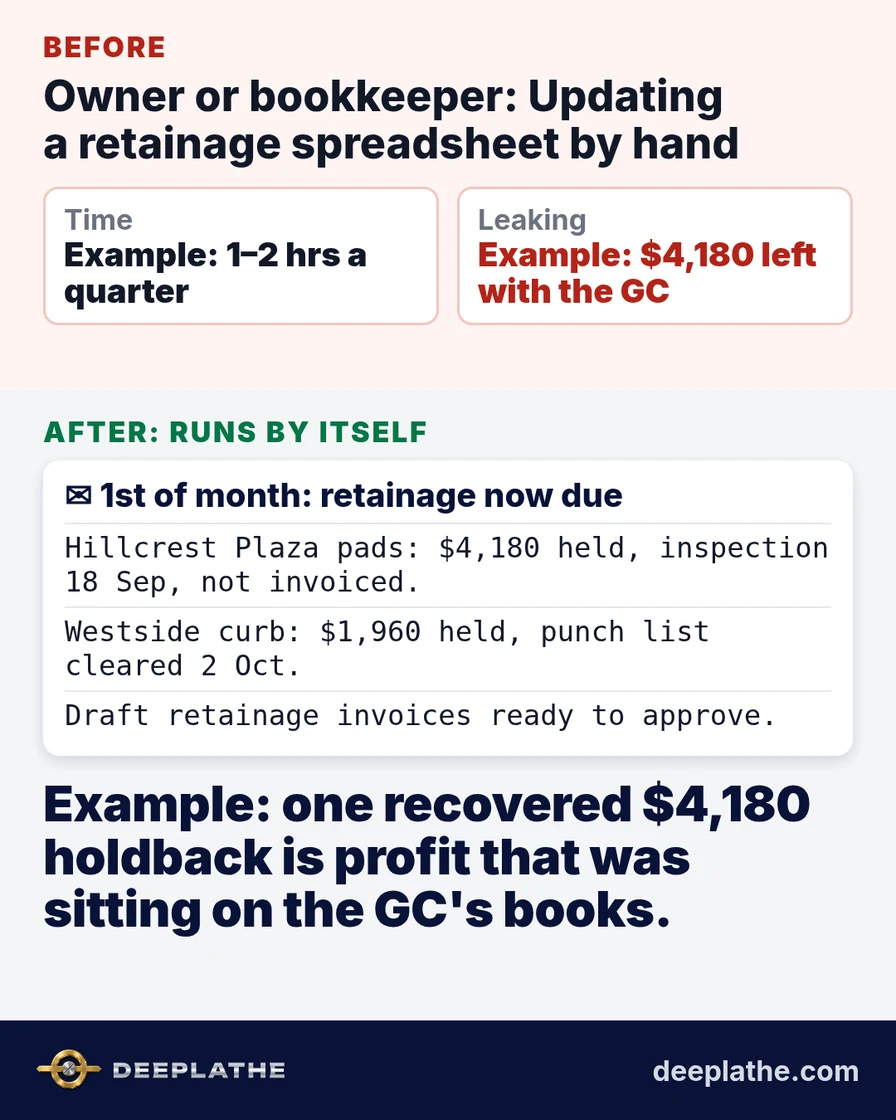
- Example: the owner or bookkeeper opens a retainage spreadsheet once a quarter and spends 1 to 2 hours matching closed jobs to unpaid holdbacks.
- Example: small holdbacks of a few thousand dollars each get skipped because they are not loud enough, and a year later you write them off or settle for less.
- Example: one $4,180 retainage left sitting six months longer than it should is cash you borrow against or leave in the GC's pocket.
In Q4 this gets worse. Commercial jobs close before year-end. General contractors release retainage only when you ask, and they are busy closing their own books. That is exactly when a quiet holdback is most likely to be forgotten.
What runs by itself
The job is a watcher on two things you already have:
- Open invoices and payment applications in QuickBooks or Xero that still show a retainage balance.
- Closeout signals in email: final inspection approvals, punch-list clear notices, certificate of substantial completion, or the GC's "final billing approved" note.
Once a month (example: the 1st at 7:00 a.m.) it decides one thing: is there retainage on a finished job whose closeout signal has already arrived and that has not been invoiced yet? If yes, that line goes on the list with the job name, the amount held, the date the signal arrived, and a drafted retainage invoice note for you to approve. If nothing is due, you get silence.
It never files a lien, never threatens a GC, and never sends an invoice without your OK. It only turns "I should remember to bill that" into a list that shows up.
This runs as a scheduled Zapier or Make step over QuickBooks or Xero plus your inbox, or as a scheduled task in ChatGPT connected to Gmail and a Drive export of open invoices. We can set this up for you inside the accounting and email tools you already use.
If you want the bigger picture of why this is different from asking a chat window every month, see automation vs a chatbot.
Example: what lands in your inbox
Illustrative sample of the 1st-of-month email:
Retainage now due (2):
Hillcrest Plaza pads: $4,180 held (10%), final inspection email 18 Sep, not invoiced.
Westside curb & gutter: $1,960 held (5%), punch list cleared 2 Oct, not invoiced.
Still held, not yet due (ignored): River Rd apron — waiting on GC final pay app.
Draft retainage invoices ready to approve.
You open two drafts, send them, and the cash clock starts.
The time and money math
Assumptions, all labeled as an example. Swap in your own numbers:
- Example: 1 to 2 hours a quarter updating a retainage spreadsheet, about 6 hours a year.
- Example: two forgotten holdbacks a year averaging $3,500 each.
- Example: collecting them six months sooner avoids interest or a cash crunch on the next pour.
Time back: the quarterly spreadsheet chase drops to under 10 minutes a month of reading a list and approving drafts. Over a year that is most of those 6 hours back, plus the mental load of "did we bill Hillcrest yet?"
Money effect: the revenue is money you already earned. Example: collecting $4,180 of retainage when it is due, instead of writing it off or settling late, is $4,180 of profit that was sitting on someone else's books. Even one recovered holdback a year pays for the setup many times over.
If you want to check these numbers against your own books first, here is how to measure AI ROI in a small business.
Quiet money is the easiest to forget. A $400 invoice gets chased. A $4,000 holdback that is contractually due but socially awkward to ask for sits. The monthly list removes the awkwardness by making the ask a routine, not a confrontation you have to invent.
Where it goes wrong (limits)
It only knows closeout signals that reach your email or accounting system. A verbal "we're good" from the GC's superintendent does not count until something lands in writing.
Retainage rules differ by contract. Some release on substantial completion, some on final payment, some in stages. The watcher flags candidates; you still decide whether the contract says it is due.
Job names must match. "Hillcrest Plaza" on the invoice and "Hillcrest Ste 200 pads" in an inspection email usually match fine; a GC that only writes a project number can confuse it. The first month, glance at each flag.
It does not give legal advice and does not start lien clocks. If a job goes unpaid past your state's notice windows, that is a separate decision with your advisor. This job is only "bill the holdback that is already due."
What if it still doesn't work for you?
If you almost never carry retainage (pure residential flatwork paid on completion), you may not need this. If your bookkeeper already invoices retainage the day inspection clears, the list will stay empty and that is a good result. If your contracts are messy and every job has a custom release rule, start with your top five commercial customers only. You lose a setup afternoon, not a new software bill.
Built inside the tools you already use
Deeplathe builds this kind of watcher inside QuickBooks or Xero and the email you already live in, so there is no new app for the field to learn. You decide what counts as "due," what it is allowed to draft, and what it may never send. If you want to see other jobs that can run this way, look at /solutions.
Questions owners ask
What does it cost to run?
It rides on a Zapier or Make plan and the QuickBooks or Xero subscription you already have, or on a paid ChatGPT plan with connectors. Compared with one forgotten $4,000 holdback, the monthly cost is small.
Will it work for a crew my size?
It fits commercial and light-commercial concrete and fencing outfits that carry retainage on more than a handful of jobs a year. A one-truck residential pour crew paid COD has little to gain.
What if it breaks or flags the wrong job?
Nothing goes out without your approval. Wrong flags get corrected once; the matcher learns your naming. If the connection drops, the task pauses and you see it.
Is my business data safe?
It reads the mailbox and books you connect, with the permissions you grant. More detail is in is customer data safe with AI tools.
Does this replace my bookkeeper?
No. It replaces the "remember to chase retainage" part. Your bookkeeper still posts the invoice and applies the payment.
Sources
- Levelset: Mechanics liens and retainage basics for contractors: plain overview of how holdbacks and payment rights show up on construction jobs (general education, not legal advice for your state).
- Xero: Job costing reports: how open job costs and balances surface in accounting software many trade firms already use.
- Zapier: ChatGPT scheduled tasks: how recurring AI checks over connected apps can run without someone opening a chat each time.
Keep these
The working rules
Retainage you are owed now shows up as a monthly "go collect this" list instead of sitting forgotten until tax time.
Floor vote
Where are you with this job?
One vote per device. Change it any time.
Loading votes…
Field check
Field check
Four questions. Honest answers. No score sent anywhere but this page.
01 / 04
Can you name the one job this piece is for, in one sentence?