AI risks
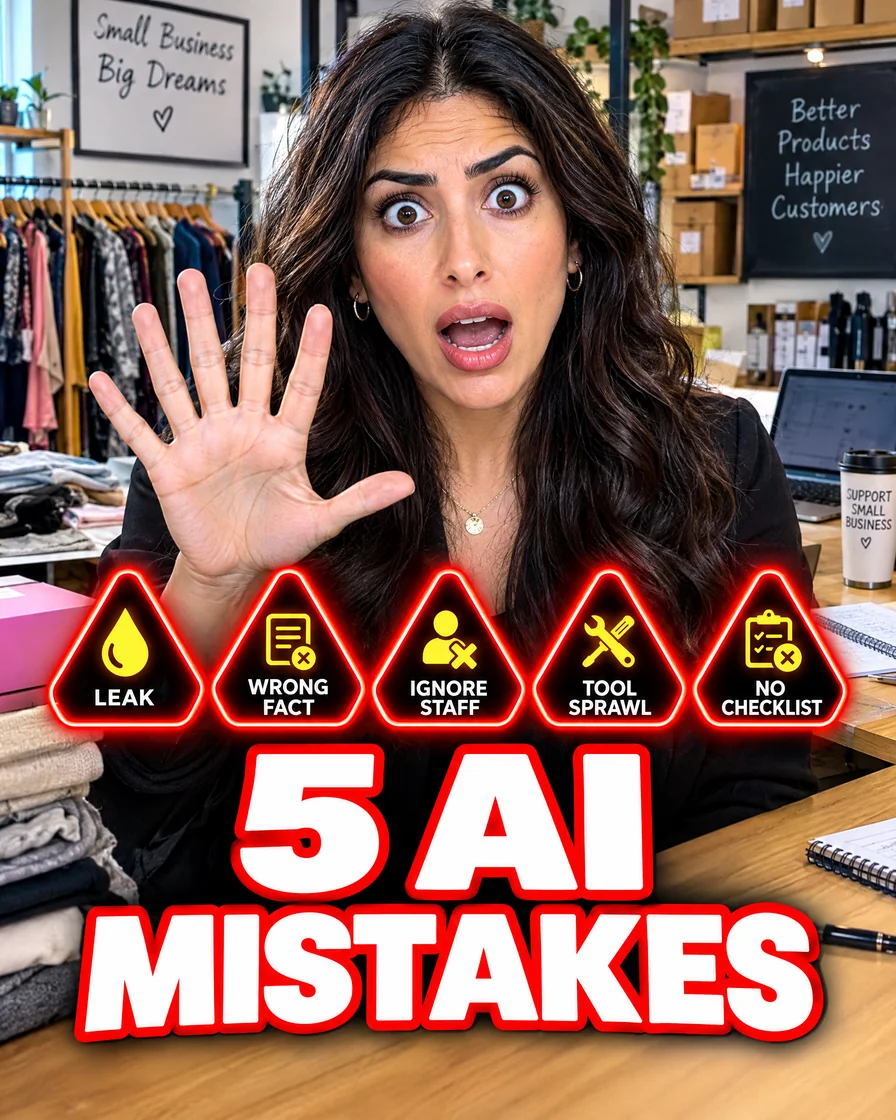
The 5 AI risks small businesses should control first
Protect customer data, catch confident mistakes, and stop tool sprawl with controls you can set up this week.
What you will be able to do
You will recognize the highest-probability AI risks for a local service business and put simple controls in place without a large IT project.
Risk 1: Pasting sensitive data into the wrong place
Staff under time pressure paste customer addresses with access codes, health details, card information, or employee records into consumer chat tools.
Control
- Publish a red list (never paste)
- Approve one work account/path
- Practice on fake examples
- Ask monthly what tools people actually used
Risk 2: Confident wrong answers
AI models can invent policies, prices, part numbers, opening hours, or medical-sounding advice in a calm tone.
Control
- Require source facts in the prompt
- Ban sending unverified numbers
- Keep a human review on outbound text
- For regulated topics, use only approved materials and qualified people
Risk 3: Brand and customer trust damage
Generic, hypey, or cold messages make a local business feel like a robocall. Customers may also dislike undisclosed automated replies when they expected a person.
Control
- Voice card with words you actually use
- One clear ask per message
- Escalation to a human for complaints
- Honesty when a channel is automated
Risk 4: Silent process breakage (automation)
An automation that mis-tags emergencies, double-texts customers, or fails quietly after a software update can do more harm than a slow human.
Control
- One owner for each automation
- Failure alerts to a person
- Monthly test of the happy path and one failure path
Risk 5: Shadow AI and sprawl
Everyone tries a different free app. Nobody shares prompts. Nobody knows where company text went.
Control
- Short approved list
- Shared prompt kit for common jobs
- Cancel duplicates at the monthly review
Risk 6: Over-reliance and skill fade
If juniors never write a clear note without a model, quality drops when the tool is down—or when the model is wrong and nobody notices.
Control
- Still train people on the underlying job
- Spot-check without AI occasionally
- Keep critical SOPs readable by humans offline
Risk 7: Legal, employment, and compliance landmines
Using AI to screen resumes, give clinical guidance, or handle regulated data can trigger obligations beyond “a chatbot handled it.”
Control
- Separate low-risk drafting from regulated decisions
- Talk to your advisor before AI touches hiring scores, health records, or credit data
- Document how tools are used when customers or auditors ask
This is not legal advice; it is a stop-and-check reminder.
Risk 8: Wasted money and attention
The quiet risk: subscriptions and half-finished pilots that distract the owner from selling and delivering work.
Control
- One job per pilot
- Day-30 keep/kill
- Cap the number of active AI experiments (one is enough for many teams)
A one-hour risk reset for this week
- List AI tools already in use (ask the team)
- Mark each green/yellow/red for data sensitivity
- Write the never-paste list
- Pick the single customer-facing workflow that uses AI
- Confirm a human reviews it
- Cancel one unused tool
That hour prevents a surprising number of ugly stories.
Keep risk proportional
A landscaper drafting blog outlines on public marketing topics is not the same risk profile as a clinic summarizing patient notes. Match controls to the data and the stakes—not to fear headlines alone.
How to brief your team without scaring them
Fear-based trainings push shadow AI underground. Better briefing:
- Approved AI uses in this shop
- Data that must never be pasted
- How outbound review works
- Who to ask when unsure
- Mistakes reported early are fixed together
People protect the business when they are trusted with clear rules. They hide tools when every experiment feels like a fireable offense.
Keep these
The working rules
Top risks: sensitive data leaks, wrong confident answers, brand damage, and tool sprawl. Then: Most failures are process failures, not “evil AI.”; Write a short allowed-tools and red-data list; Keep humans on customer-facing and high-stakes outputs; Review weekly while you are still learning.
Floor vote
Where are you with this job?
One vote per device. Change it any time.
Loading votes…
Field check
Field check
Four questions. Honest answers. No score sent anywhere but this page.
01 / 04
Can you name the one job this piece is for, in one sentence?